Language lint
kalcite lint analyses one .klc file and reports source-level risks without producing a build artifact. It complements kalcite check: check validates the program; lint calls out code that is accepted but deserves attention.
kalcite lint examples/native_escape/src/main.klc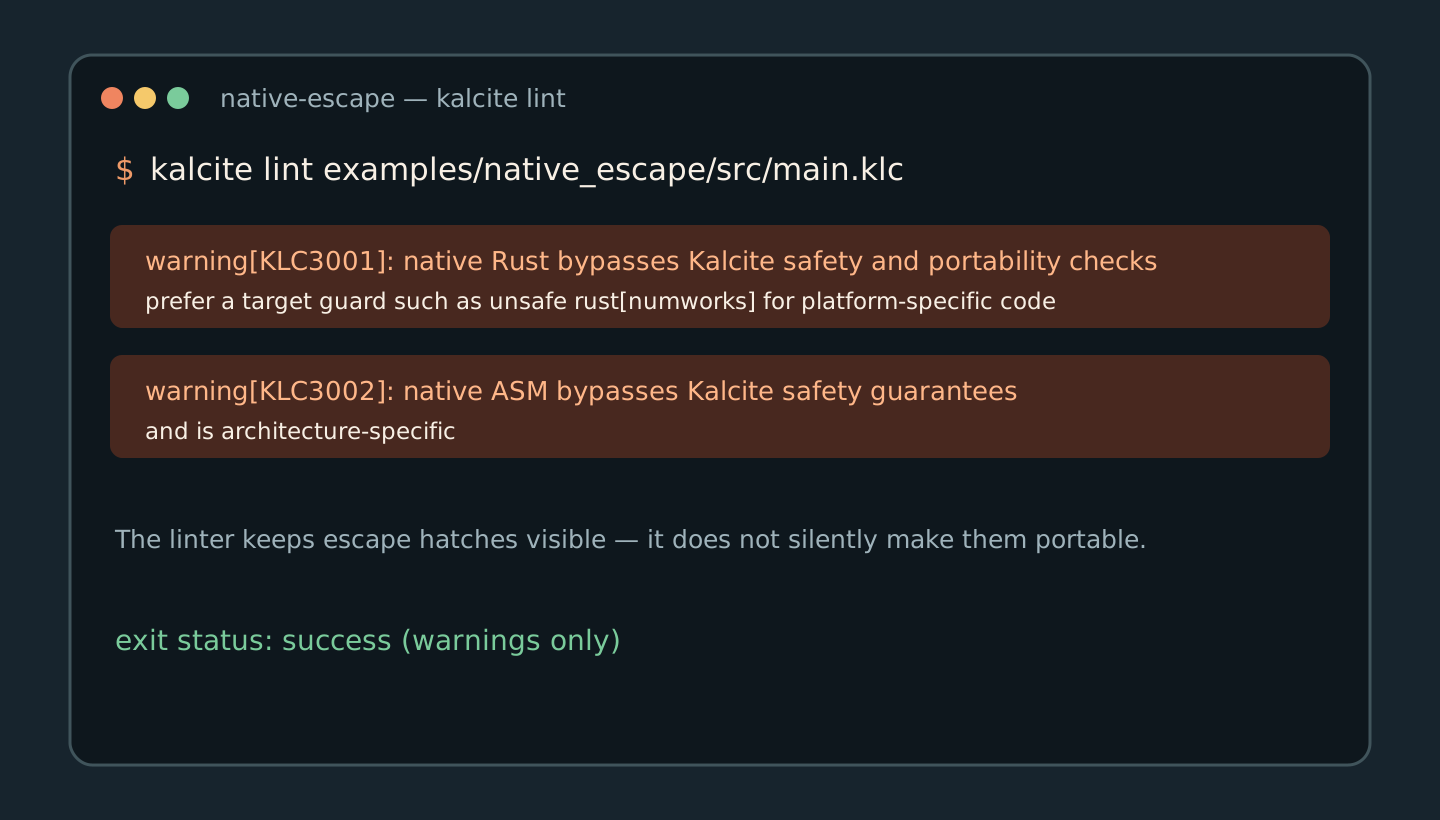
Warnings leave the command successful; one or more error-level diagnostics return a failing exit status, which makes the command suitable for CI.
Current rules
| Code | Level | Meaning |
|---|---|---|
KLC0001 | Error | The source cannot be parsed. |
KLC1001 | Warning | An Entity has no explicit @pool(N) capacity. |
KLC1002 | Error | A field uses an unbounded or heap-oriented type such as String, Vec, Box, or Rc. |
KLC1101 | Warning | An immutable @export field cannot be edited by an inspector. |
KLC1102 | Error | @node has no scene path. |
KLC1201 | Error | @pool(0) is invalid. |
KLC1202 | Warning | A pool exceeds 4096 slots and is likely unsuitable for NumWorks. |
KLC1203 | Error | A pool capacity is not a valid integer. |
KLC2001 | Warning | A public function name is only one character. |
KLC3001 | Warning | Native Rust bypasses Kalcite safety and portability checks. |
KLC3002 | Warning | Native ASM is architecture-specific and bypasses Kalcite safety guarantees. |
A bounded-memory example
@pool(32)public class Bullet extend Entity { public Vec2fx position;}The explicit capacity allows the runtime and reviewer to reason about storage. In contrast, String and Vec[T] fields produce KLC1002; use a bounded representation such as SmallString[N], [T; N], Pool[T; N], or Handle[T] where applicable.
Native escape hatches
The linter does not forbid target-specific native code. It keeps that choice visible. Keep native blocks small, target-guarded, and close to the hardware boundary:
unsafe rust[numworks] { core::hint::spin_loop();}Read the native code reference for the supported syntax and portability limits.